Customer Satisfaction Analysis: More Than Just Meeting a Requirement

Annika Perau / 15.07.2026

How satisfied are your customers—really? Many organizations ask themselves this question, whether to comply with the requirements of ISO 9001 or to continuously improve their products, services, and processes. But what exactly is a customer satisfaction analysis?

customer satisfaction analysis is a structured process used to measure and evaluate customer satisfaction systematically. Companies use methods such as customer satisfaction surveys, the Net Promoter Score (NPS), and one-on-one customer interviews to collect valuable feedback. The goal is to identify opportunities for improvement early and enhance customer satisfaction over the long term. 

Today, customer satisfaction analysis is about much more than meeting ISO 9001 requirements. Organizations that systematically evaluate customer feedback and translate insights into action can continuously improve service quality while creating sustainable competitive advantages.

Why Is Customer Satisfaction Analysis Important for Businesses?

Customer satisfaction is achieved when customer expectations are met—or even exceeded. In today's highly competitive marketplace, simply delivering the agreed-upon product or service is often no longer enough. Companies that want to build long-term customer loyalty must understand evolving customer needs and respond proactively to changing expectations. By measuring customer satisfaction on a regular basis, organizations benefit from: 

  • Stronger customer loyalty and lower customer churn
  • Higher referral rates driven by satisfied customers
  • Early identification of opportunities for improvement
  • Data-driven decision-making for process optimization
  • Support in meeting ISO 9001 requirements 

In the long run, businesses benefit not only from happier customers but also from more efficient processes and increased competitiveness.

What Methods Are Used for Customer Satisfaction Analysis?

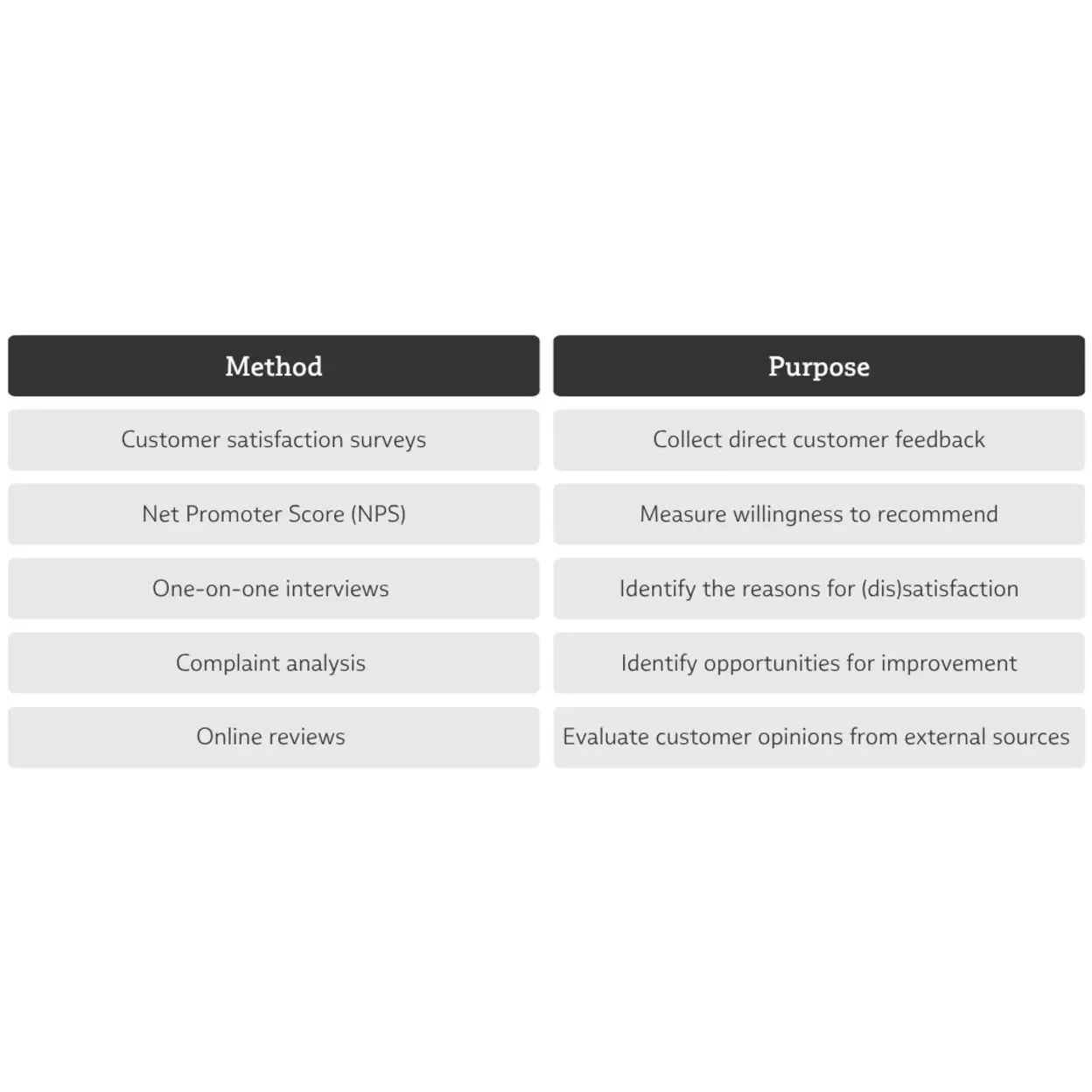
There are several ways to measure and evaluate customer satisfaction. The most suitable method depends on a company's objectives, target audience, and the level of detail required.

In practice, companies often combine multiple methods. This provides both measurable performance indicators and qualitative insights, resulting in a more comprehensive understanding of customer satisfaction. 

The Net Promoter Score (NPS): A Proven Metric

The Net Promoter Score (NPS) measures how likely customers are to recommend a company on a scale from 0 to 10, where 0 means "not at all likely" and 10 means "extremely likely." Responses are divided into three groups:

  • Ratings of 9–10 = Promoters
  • Ratings of 7–8 = Passives
  • Ratings of 0–6 = Detractors

The Net Promoter Score is calculated by subtracting the percentage of Detractors from the percentage of Promoters. It provides a quick overview of customers' willingness to recommend a company and, therefore, their overall satisfaction. Ratings from Passives are not included in the calculation, but they provide valuable insights into customers who may become Promoters through targeted improvements. The NPS is particularly useful for tracking trends over time and evaluating the effectiveness of improvement initiatives.

How Can Customer Satisfaction Be Analyzed?

While the Net Promoter Score provides an important performance metric, it does not answer the most important question: Why are customers satisfied—or dissatisfied? For this reason, organizations should combine NPS with additional sources of information, including: 

  • Open-ended customer comments
  • Analysis of individual survey responses
  • Personal conversations with customers
  • Year-over-year comparison of survey results 

Only by evaluating these data points together can businesses gain meaningful insights, identify root causes, and implement targeted improvements. Conducting customer satisfaction surveys on a regular basis also allows organizations to identify trends early and measure the long-term effectiveness of improvement efforts. 

Every Customer Is Unique - and So Is Their Feedback

Behind every rating is an individual customer experience. When a company receives critical feedback, it should review the issue together with the responsible department and then engage directly with the customer. Personal conversations often help clarify the underlying concerns and make it possible to develop solutions collaboratively. Negative feedback provides valuable opportunities to:

  • Identify improvement opportunities early
  • Optimize processes strategically
  • Strengthen customer relationships
  • Continuously improve service quality 

The ultimate goal is not only to satisfy customers but to earn their long-term trust and confidence in the company's products and services.

Customer Satisfaction Analysis: A Real-World Example

At Babtec, we continuously conduct customer satisfaction surveys. In addition to providing an NPS rating, customers have the opportunity to explain their feedback through written comments.

For example, during a customer satisfaction survey, a customer may suggest making a frequently used software feature easier to access. Together with the relevant departments, we analyze and evaluate the feedback. By discussing the issue directly with the customer, we gain a better understanding of the underlying needs and can develop potential solutions together. The resulting insights are then incorporated directly into the ongoing development of our software and future product enhancements. 

Conclusion: Customer Satisfaction Analysis Creates Long-Term Value

A customer satisfaction analysis is much more than a formal ISO 9001 requirement. It enables organizations to better understand customer expectations, identify improvement opportunities early, and continuously enhance service quality. 

Metrics such as the Net Promoter Score provide valuable guidance. However, they deliver the greatest value when combined with direct customer feedback and a structured continuous improvement process

Organizations that regularly conduct customer satisfaction analyses can systematically measure customer satisfaction, identify opportunities for improvement at an early stage, and strengthen customer loyalty over the long term. 

Looking for a structured way to capture customer feedback and turn insights into action? Learn how our software helps you conduct customer satisfaction analyses more efficiently and continuously improve customer satisfaction.