In a production facility, a man looks at two screens displaying Babtec's QM software
Quality Management

Integrated QM Software: Clarity Instead of a Patchwork of Tools

Manuel Klötzer / 08.12.2025

Today, quality is much more than just fulfilling obligations: it determines the success and market opportunities of companies. In an age of fragile supply chains and increasingly complex requirements imposed by laws, standards and demanding customers, expectations are rising not only for products, but also for processes and the people behind them. But how can quality be ensured efficiently, transparently and sustainably under these conditions?

Quality as a Company-Wide Task

The answer: Quality should not be understood as an isolated project, but as a company-wide task that affects all employees and is lived as a shared responsibility within the company. After all, those who clearly structure processes, share knowledge and focus on continuous improvement create the basis for consistently high quality and sustainable success. This only works with the right tools.

Until now, the situation in many companies has been as follows: the numerous sub-processes of quality management are handled with a wide variety of software solutions. Inspection planning, gage management, audit planning, complaints management – each in their own, not always suitable tools.

The result: important quality data is scattered across various software solutions, Excel spreadsheets and emails. This leads to duplicate data storage and often breaks in the process between different, incompatible formats. Manual data transfer also increases the effort involved and the likelihood of errors or incomplete information. Overall, such a patchwork of isolated solutions hinders the flow of information and makes it difficult to maintain a consistent view of quality-related processes.

An integrated QM solution is the alternative to such isolated software systems. Instead of numerous individual solutions connected by interfaces, it brings together all quality-related processes, data and documents in a central location. This creates transparency, reduces complexity and saves time. As a result, there are numerous advantages:


The Benefits of Integrated QM Software at a Glance

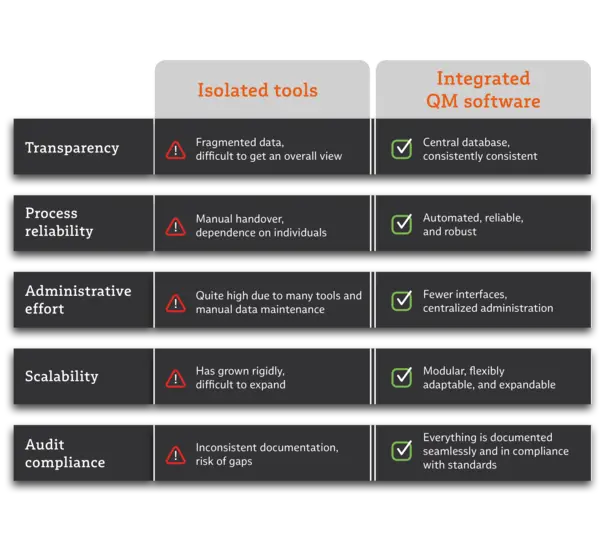
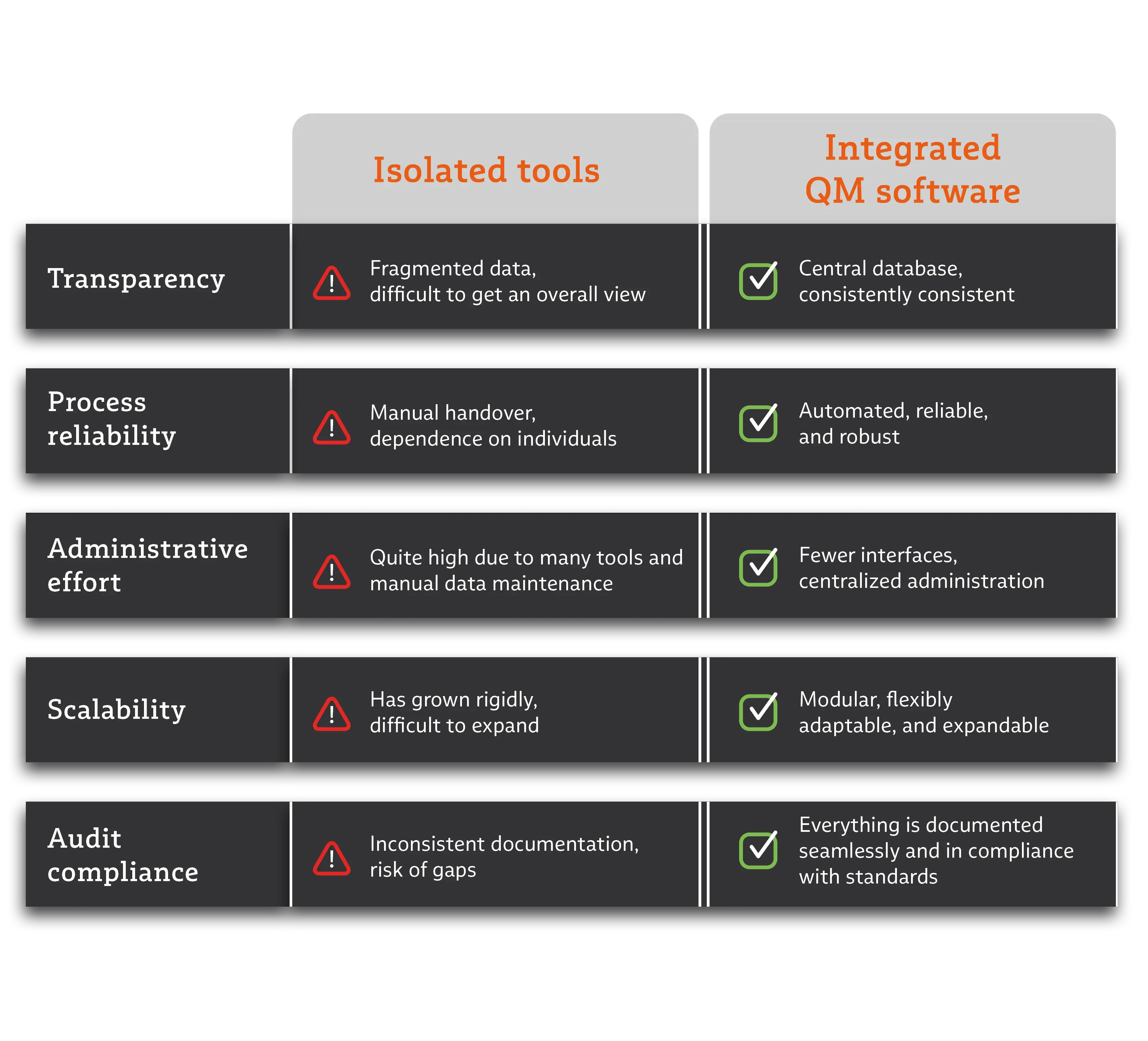
The infographic compares software silos with integrated QM software
  • Consistent processes and data integrity: Seamless links between all relevant work areas ensure shorter response times, reduced breaks in the process and fewer errors.
  • Fewer interfaces, less effort: Reduced IT complexity, lower administration costs and a central database create clear structures and greater efficiency.
  • Flexible module selection: Companies can specifically use the modules they really need – and expand the solution as needed. This creates a scalable, customized solution with long-term added value.
  • Compliance with standards and audit readiness: Integrated QM software supports compliance with standards such as ISO 9001 and also ensures complete traceability and documentation.
  • Lower costs: Because a single provider covers all relevant QM areas, fewer interfaces and less manual effort are required – which also results in cost advantages.

A use case from QM practice shows how this works in practice: Specifications defined during product development are automatically incorporated into test planning, and the results of quality tests are directly linked to the product data.

This information is then available for audits, which ensure that processes are regularly reviewed and improved. If complaints arise later, all relevant data is already stored in the software and does not need to be manually updated, as all parties involved have access to the same data.

Challenges on the Path to Integration

Of course, the introduction of an integrated solution also brings challenges. In addition to the initial investment and implementation effort, change management is crucial – because software alone does not change a culture.

Therefore, the effort is particularly noticeable at the beginning – but the benefits in everyday business are all the greater: Isolated solutions only make sense if the quality processes are not particularly complex and the requirements are rather low. Integrated QM software, on the other hand, is a sustainable, future-proof investment that helps to ensure quality in the long term and simplify processes. It supports companies in anchoring quality as a connecting element in all areas.

Fazit: Warum sich Integration lohnt

Conclusion: Why Integration Pays Off

QM software that maps all quality-related processes creates a reliable framework for managing quality consistently and transparently throughout the entire company. It makes complexity manageable, strengthens processes and provides orientation by making information available where it is actually needed.

Incidentally, the advantages mentioned do not end with operational quality assurance: a quality management system often serves as a starting point for setting up an Integrated Management System (IMS), in which topics such as quality, environmental and occupational safety management are structured in an interlinked manner – without duplicate data maintenance or parallel processes. Integrated software for quality management and IMS ensures that information is available where it is needed – from corporate management to product development and series production to complaints.

Integrated Quality Management with Babtec

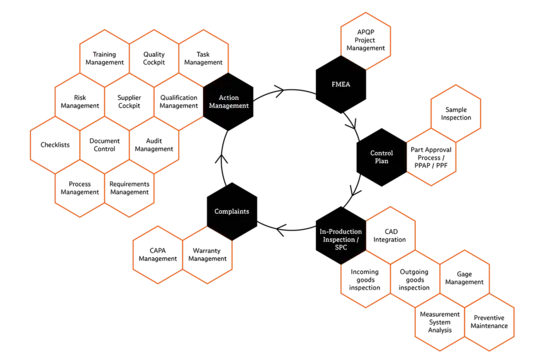
Babtec software modules in interaction

As a comprehensive solution, BabtecQ integrates all tools for quality assurance and management systems into one software. Its modular structure allows you to use exactly the solutions you need for your processes. Our webcast shows you how to map the closed quality loop with Babtec's extensive portfolio.

Comments

No comments

Write Comment

* These fields are required