Poka Yoke: Preventing Errors

/ 30.06.2026

Poka Yoke is a proven principle in quality management that helps prevent errors from occurring in the first place. Especially in production, assembly, and administrative processes, this method ensures greater reliability, less waste, and more stable processes.

What is Poka Yoke?

Poka Yoke is a simple yet highly effective concept for error prevention. The term originates from Japanese and is usually translated as “error prevention” or “error-proofing.” The essence of Poka Yoke lies in designing processes in such a way that unintentional operator errors are detected or prevented outright. 

Poka Yoke is often associated with the “zero-defect” principle. The goal is always the same: errors should not be discovered only at the end, but prevented right where they arise.

The Poka Yoke Principle

The Poka Yoke principle is based on a simple idea: People make mistakes, so systems must be designed in such a way that these mistakes do not have negative consequences. This is precisely where the strength of the Poka Yoke method lies. It does not rely solely on post-production checks, but rather on the preventive design of products, work equipment, and processes. 

Poka Yoke system can be implemented mechanically, organizationally, or digitally. The key is that it supports the correct process and detects deviations early on. This ensures that quality is not left to chance but is actively safeguarded. 

What Are the Different Types of Poka Yoke?

Generally speaking, there are several types of Poka Yoke: 

  • Preventive Poka Yoke, which prevents errors from occurring in the first place.
  • Detection-based Poka Yoke, which immediately signals an error. 
  • Warning-based Poka Yoke, which uses visual or audible alerts. 
  • Shutdown Poka Yoke, which stops a process as soon as a deviation occurs. 

In practice, these approaches are often combined. A Poka Yoke solution is particularly effective when it not only responds to errors but also prevents them from occurring in the first place or makes them much more difficult to commit.

What makes a good Poka Yoke solution?

A good Poka Yoke solution is simple, robust, and effective directly within the process. It should not require any complicated additional steps, but rather provide intuitive support to the user. The simpler the solution, the less likely it is to be circumvented in everyday use.

Key features include: 

  • It prevents errors as early as possible. 
  • It is easy to understand and requires little to no training. 
  • It is cost-effective to implement. 
  • It is tailored to the specific process. 
  • It provides immediate feedback in the event of deviations.

A good Poka Yoke concept therefore improves not only quality but also efficiency. That is precisely why this topic is so relevant to modern quality management systems. 

Poka Yoke Example from Production

A classic example of Poka Yoke is a device into which a component can only be inserted in the correct orientation. The incorrect position does not fit mechanically, thereby preventing assembly errors. Another example is a sensor that detects whether a step has been performed correctly before the next one begins.  

There are also many typical applications in manufacturing: guides, dowel pins, screw verification systems, presence detection systems, and machine interlocks. Such solutions demonstrate how a Poka Yoke system can significantly increase process reliability. 

What are some examples of Poka Yoke in everyday life?

Poka Yoke isn’t just found in industry - it’s also part of our everyday lives. Typical examples can be found in smartphones, where the SIM card - just like a USB plug - can only be inserted in the correct position. Or take the washing machine, which only starts when the door is closed and won’t open during the wash cycle. This helps prevent user errors while reducing costs and frustration. These everyday examples show just how effective the Poka Yoke principle is. Good systems support people rather than relying on them to avoid mistakes on their own.

Why Poka Yoke Is Important for Businesses

In companies, Poka Yoke helps reduce scrap, rework, and operator errors. Especially in complex processes, it is often more effective to eliminate sources of error directly rather than correcting them later at great expense. This saves time, costs, and resources. 

This method is therefore a key component of quality management. It strengthens stable processes, increases process reliability, and supports sustainable error prevention. Companies that consistently apply Poka Yoke not only improve product quality but also enhance customer satisfaction. 

Poka Yoke is more than just a method for preventing errors. It is a practical principle that makes processes simpler, safer, and more robust. Whether in production, assembly, or everyday life, a good Poka Yoke solution ensures that errors never become a problem in the first place.  

Poka Yoke is an important component of modern process design, especially for companies that prioritize consistent quality and efficient operations. Preventing errors early on lays the foundation for sustainable quality. Ultimately, however, this principle is just one of many small components of good quality management. The processes surrounding Poka Yoke must be continuously adapted and improved. You can find more information here. Furthermore, the use of high-quality CAQ software is not merely optional - it has become a necessary step toward achieving and maintaining high quality standards.


Mit Babtec zur exzellenten Qualität

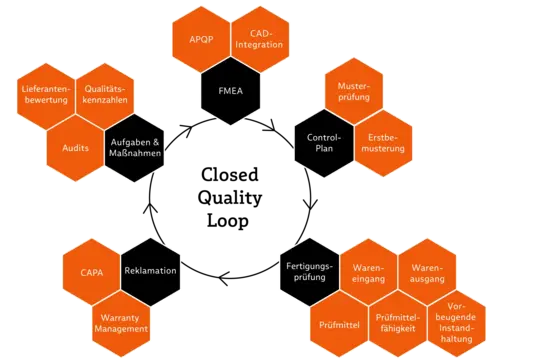
Interaction of the modules for support with operational tasks in QA and QM

In einer einzigen Softwarelösung stellt Ihnen Babtec eine Vielzahl an bewährten Modulen für die umfassende operative Unterstützung in der Qualitätssicherung und im Qualitätsmanagement bereit. Egal ob FMEA, Erstbemusterung oder Fertigungsprüfung – unser Portfolio ist im Sinne des Closed Quality Loops aufgebaut und unterstützt Sie dabei, die Qualität Ihrer Produkte sowie Prozesse sicherzustellen und Kunden zu begeistern.

Comments

No comments

Write Comment

* These fields are required